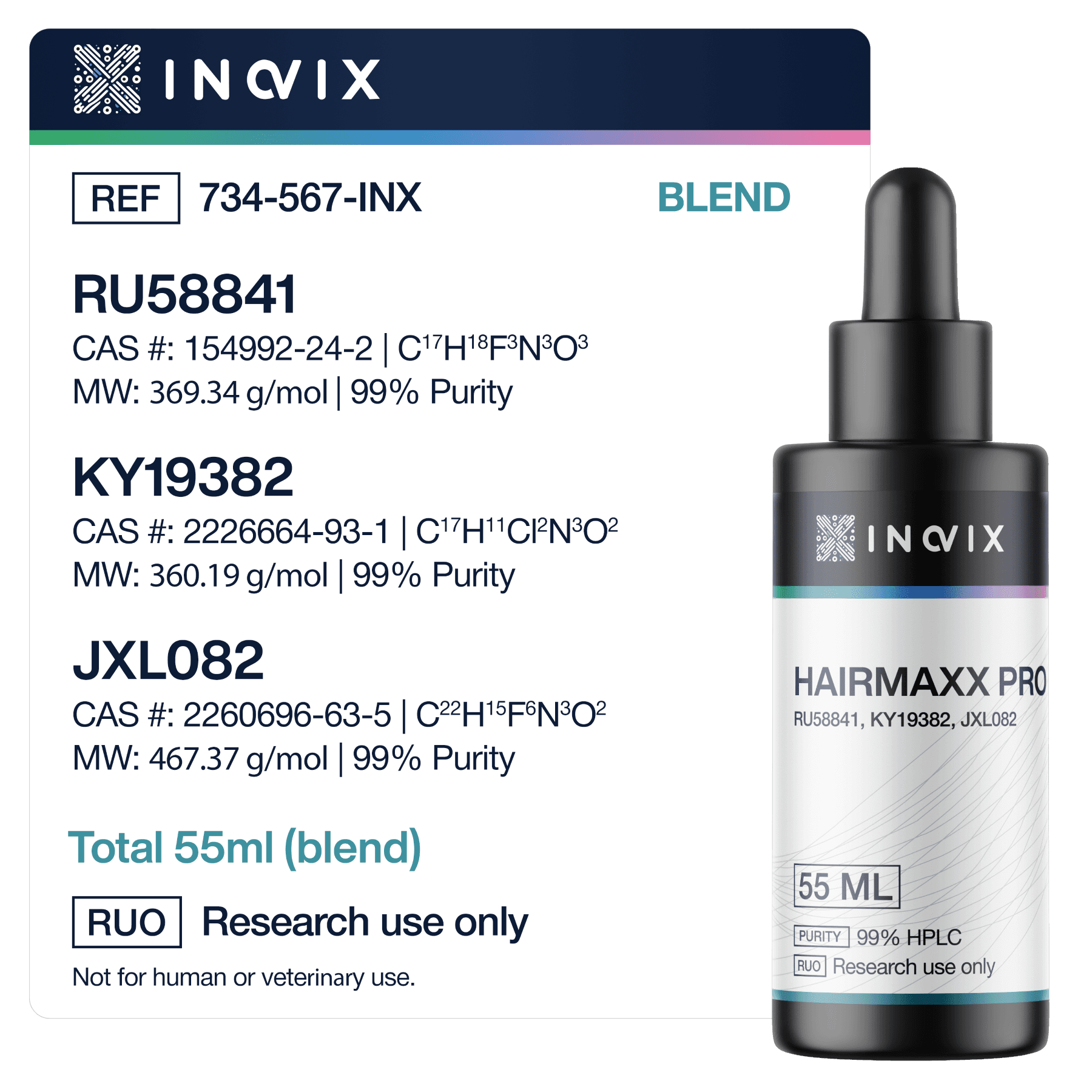
Hairmax PRO
55ml
Incl. BTW
Door dit product te bestellen bevestigt u dat u een gekwalificeerde onderzoeker bent en het uitsluitend voor laboratoriumonderzoek zult gebruiken.

Hairmax PRO
55ml Blend
| Toepassing | Uitsluitend voor in-vitro onderzoek (RUO) |
De RU58841 + KY19382 + JXL082 mix is een combinatie van kleine moleculen voor onderzoek die is ontworpen rond drie complementaire mechanismen die relevant zijn voor androgenetische alopecia, activatie van haarfollikel-stamcellen, anagen inductie, dermale papilla signalering en biologie van folliculaire regeneratie.<br><br>Deze mix combineert:<br><br>RU58841 — een topische niet-steroïdale androgenereceptorantagonist die is bestudeerd voor androgen-afhankelijke huid- en haarfollikelbiologie.<br>KY19382 — een Wnt/β-catenine signaalactivator die zowel de interactie tussen CXXC5–DVL als GSK3β remt, met sterke preklinische bewijs in haargroei, neogenese van haarfollikels en regeneratie van wondgenezing.<br>JXL082 — een remmer van mitochondriale pyruvaatdragers uit de UK-5099/JXL-serie, ontwikkeld in het onderzoeksprogramma dat MPC-remming, lactaatmetabolisme en activatie van haarfollikel-stamcellen onderzoekt.<br><br>Samen creëren deze drie verbindingen een onderzoeksplatform dat zich richt op drie belangrijke biologische controlepunten in haarbiologie: androgenensignalisatie, Wnt-afhankelijke folliculaire regeneratie en metabolische activatie van quiescente follikel-stamcellen. [1–17]
Blend Overview
Androgenetic alopecia is driven by a convergence of androgen receptor signaling, follicular miniaturization, shortened anagen duration, impaired dermal papilla signaling, reduced Wnt/β-catenin activity, and altered hair follicle stem-cell activation. A single-pathway approach can be useful, but a multi-pathway strategy allows the biology to be approached from several complementary angles.
The RU58841 + KY19382 + JXL082 blend is structured around:
1. Local antiandrogenic support
RU58841 blocks androgen receptor signaling at the receptor level. In follicle biology, this is relevant because DHT-mediated androgen receptor activation is a central driver of follicular miniaturization in androgen-sensitive scalp regions.
2. Regenerative Wnt/β-catenin activation
KY19382 restores Wnt/β-catenin signaling by blocking the inhibitory CXXC5–DVL interaction and inhibiting GSK3β. Wnt/β-catenin activity is essential for dermal papilla function, anagen induction, follicle cycling, hair shaft growth, and wound-induced hair follicle neogenesis.
3. Metabolic reactivation of follicle stem cells
JXL082 belongs to the mitochondrial pyruvate carrier inhibitor series developed to alter follicle metabolism. MPC inhibition shifts pyruvate handling away from mitochondrial oxidative entry and toward lactate-associated glycolytic metabolism. Lactate dehydrogenase activity is strongly linked to hair follicle stem-cell activation and entry into the growth phase.
This blend is therefore positioned as a triple-mechanism hair regeneration research blend: antiandrogenic, Wnt-activating, and metabolically pro-anagen.
Blend Structure and Compound Identity
This blend contains three chemically distinct small molecules. None of the three are peptides, so amino-acid length and sequence are not applicable.
RU58841
RU58841 is a nonsteroidal antiandrogen also known as PSK-3841 or HMR-3841. It belongs to the aryl hydantoin antiandrogen class and has been studied as a topical androgen receptor antagonist for androgen-dependent skin disorders including acne, androgenetic alopecia, and hirsutism. [1,4–7]
CAS No.: 154992-24-2
PubChem CID: 132981
Molecular Formula: C17H18F3N3O3
Molecular Weight: 369.34 g/mol
Compound Class: Nonsteroidal androgen receptor antagonist
Synonyms: RU58841; RU-58841; PSK-3841; HMR-3841
Solubility: RU58841 is commonly reported as DMSO-soluble. Technical data list DMSO solubility up to ≥100 mg/mL in some supplier documentation, while other product specifications report solubility in DMSO up to 22 mM. Final solubility should follow the exact batch COA and formulation system. [1,2]

Source: PubChem. RU58841 compound entry, 2D structure image, CID 132981.
KY19382
KY19382 is an indirubin-derived small molecule that activates Wnt/β-catenin signaling by inhibiting both CXXC5–DVL protein-protein interaction and GSK3β. It has been studied in hair regrowth, hair follicle neogenesis, wound healing, dermal papilla cell activation, and metabolic-disease models. [8–12]
CAS No.: 2226664-93-1
PubChem CID: 148959784
Molecular Formula: C17H11Cl2N3O2
Molecular Weight: 360.19 g/mol
Compound Class: CXXC5–DVL / GSK3β dual inhibitor; Wnt/β-catenin activator
Synonyms: KY19382; KY-19382; KY 19382; A3051
Reported activity: CXXC5–DVL IC50 ≈ 19 nM; GSK3β IC50 ≈ 10 nM
Solubility: KY19382 is commonly reported as DMSO-soluble and water-insoluble. Some supplier data list DMSO solubility around 2 mg/mL. Final solubility and formulation conditions should follow the exact batch COA. [8–10]

Source: PubChem. KY19382 compound entry, 2D structure image, CID 148959784.
JXL082
JXL082 is a mitochondrial pyruvate carrier inhibitor from the UCLA/Pelage-related UK-5099 analogue research series. It is structurally related to other α-cyanoacrylate MPC inhibitors such as JXL069 and UK-5099 / JXL001. It has been described in the scientific literature as part of a medicinal-chemistry program developing mitochondrial pyruvate carrier inhibitors for hair-loss research. [13–17]
CAS No.: 2260696-75-9
PubChem CID: 137384919
Molecular Formula: C22H15F6N3O2
Molecular Weight: 467.37 g/mol
Compound Class: Mitochondrial pyruvate carrier inhibitor
IUPAC Name: ethyl (E)-3-[1-[[3,5-bis(trifluoromethyl)phenyl]methyl]pyrrolo[2,3-b]pyridin-3-yl]-2-cyanoprop-2-enoate
Synonyms: JXL082; JXL-082; JXL 082
Solubility: Public solubility data for JXL082 are limited and batch-dependent. As a fluorinated, aromatic ethyl cyanoacrylate-type small molecule, it is typically handled in organic-solvent research systems. Final solubility and formulation specifications should follow the exact batch COA. [13–16]

Source: PubChem. JXL082 compound entry, 2D structure image, CID 137384919.
Mechanistic Rationale of the Blend
The blend is designed around three different but biologically convergent pathways in androgenetic alopecia research.
RU58841 targets androgen receptor signaling.
KY19382 targets regenerative Wnt/β-catenin signaling.
JXL082 targets follicular metabolism through mitochondrial pyruvate carrier inhibition.
This combination gives the blend a broad mechanistic profile:
Androgen receptor antagonism
Limits DHT-driven receptor signaling at the follicle level.
Wnt/β-catenin pathway restoration
Supports dermal papilla activation, follicle growth signaling, anagen progression, and follicle neogenesis.
MPC inhibition and lactate-linked stem-cell activation
Supports the metabolic transition associated with hair follicle stem-cell activation and growth-phase entry.
Dermal papilla and epithelial support
KY19382 increases Wnt/β-catenin signaling, dermal papilla activity, alkaline phosphatase activity, β-catenin localization, proliferation markers, and regenerative follicle signaling.
Pro-anagen follicle biology
The combined target profile supports anagen induction, hair shaft elongation, and follicle activation in preclinical research models.
RU58841: Androgen Receptor Antagonism
RU58841 was developed as a topically active nonsteroidal antiandrogen. Its core value in the blend is local androgen receptor antagonism. In androgenetic alopecia, DHT binds androgen receptors in genetically susceptible hair follicles, leading to follicular miniaturization, shortened anagen duration, altered dermal papilla signaling, and progressive thinning.
RU58841 acts at the receptor level rather than by inhibiting 5α-reductase. This means the compound is designed to block androgen receptor activation without directly reducing systemic androgen production. In preclinical studies, RU58841 showed high affinity for androgen receptors from hamster prostate and flank organ tissue and demonstrated topical antiandrogenic activity in androgen-sensitive skin structures. [4]
The topical antiandrogen concept is especially relevant to scalp research because androgen receptor signaling is spatially important: follicles in androgen-sensitive scalp regions respond differently than follicles in non-balding regions. A locally acting androgen receptor antagonist is therefore a rational tool for research into follicular miniaturization, DHT response, sebaceous biology, acne biology, and androgen-dependent hair growth regulation. [4–7]
RU58841: Hair Growth and Macaque Research
RU58841 has been studied in the stumptailed macaque model of androgenetic alopecia, one of the more relevant animal models for pattern hair loss research. In that model, topical RU58841 was associated with increased hair density, thickening, and hair length, while no systemic effects were detected in the reported study. [5]
This finding supports the concept of RU58841 as a locally active antiandrogen for follicular research. It provides a strong rationale for including RU58841 as the antiandrogenic component in a blend designed for androgen-sensitive follicle biology.
The macaque data are especially important because they link androgen receptor antagonism directly to measurable hair-growth endpoints in an androgen-dependent hair-loss model. In blend design, RU58841 is therefore the component that addresses the androgenic suppression side of the hair-loss mechanism.
RU58841: Pharmacokinetics, Metabolism, and Topical Design
Early pharmacokinetic work found that RU58841 and related aryl hydantoin antiandrogens disappear relatively rapidly from rat plasma after intravenous administration, while forming metabolites including the common N-desalkyl derivative RU56279. This pharmacokinetic profile helped drive interest in topical design strategies to maximize local skin effects while minimizing systemic exposure. [6]
Topical prodrug and formulation research later explored RU58841-myristate and solid lipid nanoparticle-based approaches for androgenetic alopecia and acne. The aim was to direct the antiandrogenic effect toward diseased skin and follicular compartments, using lipophilic carrier strategies to improve follicular delivery. [7]
This makes RU58841 a strong fit in a topical hair research blend. Its role is not to stimulate follicle growth directly through regenerative pathways, but to reduce the androgen receptor signal that contributes to miniaturization and anagen shortening.
KY19382: Wnt/β-Catenin Activation
KY19382 is the regenerative signaling component of the blend. It activates Wnt/β-catenin signaling through two complementary mechanisms:
1. CXXC5–DVL inhibition
CXXC5 is a negative regulator of Wnt/β-catenin signaling. It suppresses Wnt activity by interacting with Dishevelled. Blocking this interaction releases an inhibitory brake on Wnt pathway activation.
2. GSK3β inhibition
GSK3β normally contributes to β-catenin degradation. Inhibiting GSK3β supports β-catenin stabilization and pathway activation.
This dual mechanism gives KY19382 a strong pro-regenerative profile. In hair biology, Wnt/β-catenin signaling is central to hair follicle development, dermal papilla activity, anagen induction, and wound-induced hair follicle neogenesis. [8–12]
KY19382: Hair Regrowth and Hair Follicle Neogenesis
The core KY19382 hair-regrowth paper showed that KY19382 activates Wnt/β-catenin signaling and promotes hair regeneration across multiple experimental systems. It increased hair induction activity in dermal papilla cells, increased alkaline phosphatase activity, elevated proliferation markers, and promoted both hair regrowth and hair follicle neogenesis. [8]
In mouse hair-regrowth models, KY19382 promoted anagen induction and hair regrowth. In hairless mouse neogenesis models and patch assays, it supported formation of new hair follicles. In ex vivo human hair follicle culture, KY19382 increased hair shaft elongation, supporting relevance beyond mouse-only systems. [8]
This evidence makes KY19382 the primary pro-regenerative signaling activator in the blend. While RU58841 reduces androgenic suppression, KY19382 supports the follicle’s regenerative and growth-promoting signaling environment.
KY19382: DHT, PGD2, CXXC5, and Androgenetic Alopecia Mechanism
A major mechanistic extension of KY19382 research comes from the study of DHT-induced androgenetic alopecia via the PGD2–CXXC5 axis. In this model, DHT increased PTGDS and PGD2, which in turn induced CXXC5. CXXC5 then suppressed Wnt/β-catenin signaling, linking androgenic signaling to Wnt pathway inhibition. [11]
KY19382 treatment recovered DHT-mediated suppression of hair growth by restoring Wnt/β-catenin signaling and alkaline phosphatase activity. In mice treated with DHT, topical KY19382 promoted hair regrowth, increased dermal thickness, increased the number of hair follicles, and shifted follicles toward anagen-stage features. [11]
This mechanism gives the blend a strong internal logic. RU58841 targets the androgen receptor side of DHT biology, while KY19382 supports recovery of Wnt/β-catenin signaling downstream of androgen-linked suppression.
KY19382: Wound Healing and Regenerative Skin Biology
KY19382 has also been studied in cutaneous wound-healing models. In human keratinocytes and dermal fibroblasts, KY19382 increased cell migration and proliferation, increased β-catenin signaling, and elevated markers such as PCNA, keratin 14, collagen I, and α-SMA. [9]
In mouse wound models, KY19382 accelerated cutaneous wound healing, promoted collagen deposition, enhanced re-epithelialization, supported neo-epidermis formation, and increased stem-cell-associated markers such as CD34 and Nestin in wounded skin. [9]
This wound-healing research is relevant to hair regeneration because hair follicle cycling and wound-induced follicle neogenesis share overlapping Wnt-dependent regenerative mechanisms. KY19382 therefore contributes not only to follicle-specific signaling but also to broader regenerative skin biology.

Source: Yoon M, Park J, et al. KY19382 Accelerates Cutaneous Wound Healing via Activation of the Wnt/β-Catenin Signaling Pathway. International Journal of Molecular Sciences. 2023. Figure 1: KY19382 effects on migration and Wnt/β-catenin activation in human keratinocytes. License: CC BY 4.0.

Source: Yoon M, Park J, et al. KY19382 Accelerates Cutaneous Wound Healing via Activation of the Wnt/β-Catenin Signaling Pathway. International Journal of Molecular Sciences. 2023. Figure 3: KY19382 accelerates cutaneous wound healing and collagen deposition in a mouse wound model. License: CC BY 4.0.

Source: Yoon M, Park J, et al. KY19382 Accelerates Cutaneous Wound Healing via Activation of the Wnt/β-Catenin Signaling Pathway. International Journal of Molecular Sciences. 2023. Figure 4: KY19382 increases β-catenin activation, re-epithelialization markers, and stem-cell-associated markers in wound tissue. License: CC BY 4.0.
KY19382: PKM2, Metabolic Signaling, and Hair Regeneration
KY19382 also appears in research connecting Wnt/β-catenin signaling to metabolic regulation in hair follicles. In the PKM2 hair-regeneration study, KY19382 was used as the Wnt/β-catenin activator component in combination with TEPP-46, a PKM2 activator. [10]
The combined treatment significantly enhanced hair regrowth, increased hair weight, increased dermal thickness, increased follicle number, promoted anagen induction, and increased stem-cell-region markers including β-catenin and PKM2. [10]
This research is highly relevant to the RU58841 + KY19382 + JXL082 blend because it shows that regenerative Wnt signaling and metabolic activation can be combined to enhance hair-follicle outcomes. KY19382 provides Wnt/β-catenin activation, while JXL082 represents the metabolic arm of the blend.

Source: Ryu YC, Kim Y-R, Park J, et al. Pyruvate Kinase M2 Promotes Hair Regeneration by Connecting Metabolic and Wnt/β-Catenin Signaling. Pharmaceutics. 2022. Figure 3: combined TEPP-46 and KY19382 treatment promotes hair regrowth and hair follicle stem-cell activation. License: CC BY 4.0.

Source: Ryu YC, Kim Y-R, Park J, et al. Pyruvate Kinase M2 Promotes Hair Regeneration by Connecting Metabolic and Wnt/β-Catenin Signaling. Pharmaceutics. 2022. Figure 4: KY19382 and TEPP-46 enhance wound-induced hair follicle neogenesis. License: CC BY 4.0.
JXL082: Mitochondrial Pyruvate Carrier Inhibition
JXL082 represents the metabolic stem-cell activation component of the blend. It belongs to the class of mitochondrial pyruvate carrier inhibitors, structurally related to UK-5099 and JXL069. [13–17]
The mitochondrial pyruvate carrier moves pyruvate from the cytosol into mitochondria for oxidative metabolism. When MPC activity is inhibited, pyruvate entry into mitochondria is reduced, shifting metabolism toward glycolysis and lactate production. In hair follicle stem-cell biology, lactate metabolism is strongly linked to activation of quiescent follicle stem cells and entry into the growth phase. [13–17]
This makes JXL082 mechanistically complementary to KY19382. KY19382 activates regenerative Wnt signaling, while JXL082 targets the metabolic state of the follicle stem-cell niche.
JXL082: Relationship to UK-5099, JXL069, and Hair Growth Research
The 2021 Journal of Medicinal Chemistry paper developed novel analogues of UK-5099 for hair-loss research. These compounds were designed around the α-cyanoacrylate MPC inhibitor scaffold, with modifications to improve potency, selectivity, topical performance, and hair-growth-related activity. JXL082 appears within this medicinal-chemistry series as an ethyl ester analogue connected to the development of more optimized MPC inhibitors. [13]
In vivo testing of related MPC inhibitors showed topical hair-growth activity in mice, with pigmentation and hair growth indicating entry into anagen after treatment. The research program established MPC inhibition as a credible target for hair follicle stem-cell activation and hair regeneration. [13,14]
JXL082 is therefore best positioned as a research-grade MPC inhibitor within the hair-follicle metabolic reactivation strategy. Its role in the blend is to support the metabolic switch associated with follicle stem-cell activation.
Hair Follicle Stem Cells, Lactate, and Metabolic Activation
Hair follicle stem cells move between quiescence and activation during the hair cycle. Metabolic state is one of the regulators of this transition. The foundational lactate research showed that lactate dehydrogenase activity is enriched in hair follicle stem cells and that lactate metabolism can drive hair follicle stem-cell activation. [15]
This is the central biological rationale behind MPC inhibition in hair research. By limiting pyruvate import into mitochondria, MPC inhibitors can increase cytosolic pyruvate availability for conversion to lactate through LDH activity. Increased lactate-associated glycolytic metabolism is linked to follicle stem-cell activation and anagen entry. [15,16]
The JXL082 component therefore gives the blend a metabolic mechanism distinct from both RU58841 and KY19382. RU58841 addresses androgen receptor signaling. KY19382 addresses Wnt/β-catenin regeneration. JXL082 addresses metabolic activation of the follicle stem-cell niche.
Three-Pathway Blend Logic
The blend is designed to approach hair biology through three synchronized pathways.
1. Antiandrogenic Control
RU58841 reduces androgen receptor signaling at the follicle level. This is relevant to DHT-driven miniaturization, shortened anagen duration, and androgen-sensitive follicle suppression.
2. Regenerative Signal Activation
KY19382 restores Wnt/β-catenin signaling, a central driver of dermal papilla function, anagen induction, hair shaft production, and follicle neogenesis.
3. Metabolic Stem-Cell Reactivation
JXL082 inhibits mitochondrial pyruvate carrier activity, supporting a lactate-associated metabolic state linked to hair follicle stem-cell activation.
Together, these three mechanisms create a biologically coherent blend for research into androgen-sensitive hair loss, follicle regeneration, and dormant follicle activation.
Blend Research Positioning
This blend is especially relevant for research into:
Androgenetic alopecia biology
RU58841 targets androgen receptor activity while KY19382 addresses downstream Wnt suppression associated with DHT/PGD2/CXXC5 signaling.
Hair follicle stem-cell activation
JXL082 targets the metabolic switch connected to lactate production and HFSC activation.
Anagen induction
KY19382 and MPC inhibition both support entry into growth-associated follicle states through different pathways.
Dermal papilla signaling
KY19382 directly activates Wnt/β-catenin signaling in dermal papilla-related systems.
Follicle miniaturization research
The combination of antiandrogenic and regenerative mechanisms makes the blend relevant to miniaturized, androgen-sensitive follicle models.
Wound-induced hair follicle neogenesis
KY19382 has direct evidence in WIHN models and works through regenerative Wnt signaling.
Metabolic regeneration
JXL082 belongs to the MPC inhibitor class used to study mitochondrial pyruvate handling, lactate biology, and stem-cell activation.
Component Synergy
The blend is built on the idea that androgenetic alopecia is not controlled by one signal alone. DHT-driven androgen receptor activation suppresses follicular growth, while reduced Wnt/β-catenin signaling and altered metabolic activity keep follicles in weaker or more dormant states.
RU58841 reduces the suppressive androgen receptor signal.
KY19382 restores regenerative Wnt signaling.
JXL082 supports metabolic conditions associated with follicle stem-cell activation.
This creates a research profile aimed at both removing inhibitory signaling and activating regenerative signaling.
Blend Summary
The RU58841 + KY19382 + JXL082 blend is a triple-mechanism hair research combination built around androgen receptor antagonism, Wnt/β-catenin activation, and mitochondrial pyruvate carrier inhibition.
Its core scientific rationale is:
RU58841 — blocks androgen receptor signaling relevant to DHT-sensitive follicular miniaturization.
KY19382 — activates Wnt/β-catenin signaling through CXXC5–DVL and GSK3β inhibition, supporting dermal papilla function, anagen induction, hair regrowth, and follicle neogenesis.
JXL082 — targets mitochondrial pyruvate transport, supporting the lactate-associated metabolic switch linked to hair follicle stem-cell activation.
This blend is best positioned as a multi-pathway topical hair-regeneration research blend for studying androgen-sensitive hair loss, dormant follicle reactivation, Wnt-driven regeneration, and metabolic activation of the hair follicle stem-cell niche.
Selected References
PubChem. RU58841 compound entry, CID 132981. Chemical structure, formula, molecular weight, identifiers, and synonyms.
MedChemExpress. RU-58841 Data Sheet. CAS, formula, molecular weight, target, storage, and solubility information.
Cellagen Technology. RU58841 Product Specification. Chemical formula, CAS, molecular weight, purity, appearance, and DMSO solubility.
Battmann T, et al. RU 58841, a new specific topical antiandrogen. Journal of Steroid Biochemistry and Molecular Biology. 1994.
Pan HJ, et al. Evaluation of RU58841 as an anti-androgen in prostate PC3 cells and a topical anti-alopecia agent in the bald scalp of stumptailed macaques. 1998.
Cousty-Berlin D, et al. Preliminary pharmacokinetics and metabolism of novel non-steroidal antiandrogens in the rat: relation of their systemic activity to the formation of a common metabolite. Journal of Steroid Biochemistry and Molecular Biology. 1994.
Münster U, et al. RU 58841-myristate—prodrug development for topical treatment of acne and androgenetic alopecia. Die Pharmazie. 2005.
Ryu YC, Lee DH, Shim J, Park J, Kim YR, Choi S, et al. KY19382, a novel activator of Wnt/β-catenin signalling, promotes hair regrowth and hair follicle neogenesis. British Journal of Pharmacology. 2021.
Yoon M, Park J, et al. KY19382 Accelerates Cutaneous Wound Healing via Activation of the Wnt/β-Catenin Signaling Pathway. International Journal of Molecular Sciences. 2023.
Ryu YC, Kim YR, Park J, et al. Pyruvate Kinase M2 Promotes Hair Regeneration by Connecting Metabolic and Wnt/β-Catenin Signaling. Pharmaceutics. 2022.
Ryu YC, Park J, Kim YR, et al. CXXC5 Mediates DHT-Induced Androgenetic Alopecia via PGD2. Cells. 2023.
MedChemExpress. KY19382 Data Sheet. CXXC5–DVL and GSK3β activity, formula, storage, and biological activity.
Liu X, Flores AA, Situ L, Gu W, Ding H, Christofk HR, Lowry WE, Jung ME. Development of Novel Mitochondrial Pyruvate Carrier Inhibitors to Treat Hair Loss. Journal of Medicinal Chemistry. 2021.
UCLA / Jung Group PDF. Development of Novel Mitochondrial Pyruvate Carrier Inhibitors to Treat Hair Loss. Full-text manuscript and figure captions.
Flores A, Schell J, Krall AS, et al. Lactate dehydrogenase activity drives hair follicle stem cell activation. Nature Cell Biology. 2017.
Patent WO2019006359A1. Compositions and methods for modulating hair growth. MPC inhibition, LDH activation, lactate production, and hair growth methods.
Synthetika / public compound data. JXL-082 / JXL082. CAS, PubChem CID, ChEMBL ID, formula, molecular weight, IUPAC name, and SMILES.
Voor uw onderzoek
Kwaliteit en analyse
Hoe elke batch wordt getest: HPLC-zuiverheid, LC-MS-identiteit en onafhankelijke verificatie.
Lees meerReconstitutiecalculator
Bereken de concentratie van uw stamoplossing in mg/mL.
Lees meerOplosbaarheid en opslag
Oplosmiddelen, opslagtemperaturen en houdbaarheid van alle verbindingen in één tabel.
Lees meerVerzonden vanuit Nederland
DHL Parcel vanuit Nederland
Elke bestelling wordt vanuit Nederland verzonden met DHL Parcel, met track & trace tot aflevering. Levering in Nederland: 1 tot 2 werkdagen.
Geen douane binnen de EU
Uw pakket blijft binnen de EU-binnenmarkt. Voor EU-bestemmingen is er geen douanecontrole, geen invoer-BTW en geen inklaringskosten bij aflevering.
Prijzen in euro, incl. BTW
Alle prijzen zijn in euro en inclusief BTW. Binnen de EU komen er achteraf geen invoerkosten of extra heffingen bij.
Verzendkosten per land
- Nederland€ 6,95gratis vanaf € 75,00
- België€ 10,95gratis vanaf € 75,00
- Duitsland€ 13,95gratis vanaf € 75,00
- Frankrijk€ 15,95gratis vanaf € 250,00
- Verenigd Koninkrijk€ 18,95gratis vanaf € 250,00
- Italië€ 20,95gratis vanaf € 250,00
- Spanje€ 22,95gratis vanaf € 250,00
- Denemarken€ 28,95gratis vanaf € 250,00
- Zweden€ 29,95gratis vanaf € 250,00
Dezelfde DHL-tarieven die u bij het afrekenen ziet.
Veelgestelde vragen
Wat is Hairmax PRO?+
55ml. Hairmax PRO is uitsluitend bestemd voor in-vitro laboratoriumonderzoek (research use only) en is niet bedoeld voor menselijke of veterinaire toepassing.
Kan ik Hairmax PRO kopen voor onderzoek?+
Ja, Hairmax PRO is online te bestellen voor laboratoriumonderzoek. Bestellen is voorbehouden aan gekwalificeerde onderzoekers: bij het plaatsen van een bestelling bevestigt u dat het product uitsluitend voor onderzoeksdoeleinden wordt gebruikt. Inovix levert binnen Europa.
Wordt Hairmax PRO binnen Europa verzonden?+
Ja. Inovix verzendt vanuit Nederland met DHL naar negen Europese landen, waaronder Nederland, België en Duitsland. Elke zending heeft track & trace tot aflevering.
Is Inovix een betrouwbare Europese leverancier van onderzoekspeptiden?+
Inovix is een Nederlandse leverancier van producten voor laboratoriumonderzoek. Analyses worden uitgevoerd door onafhankelijke laboratoria in de EU en het certificaat van analyse is per product te downloaden waar vermeld. Verzending gebeurt vanuit Nederland met track & trace.