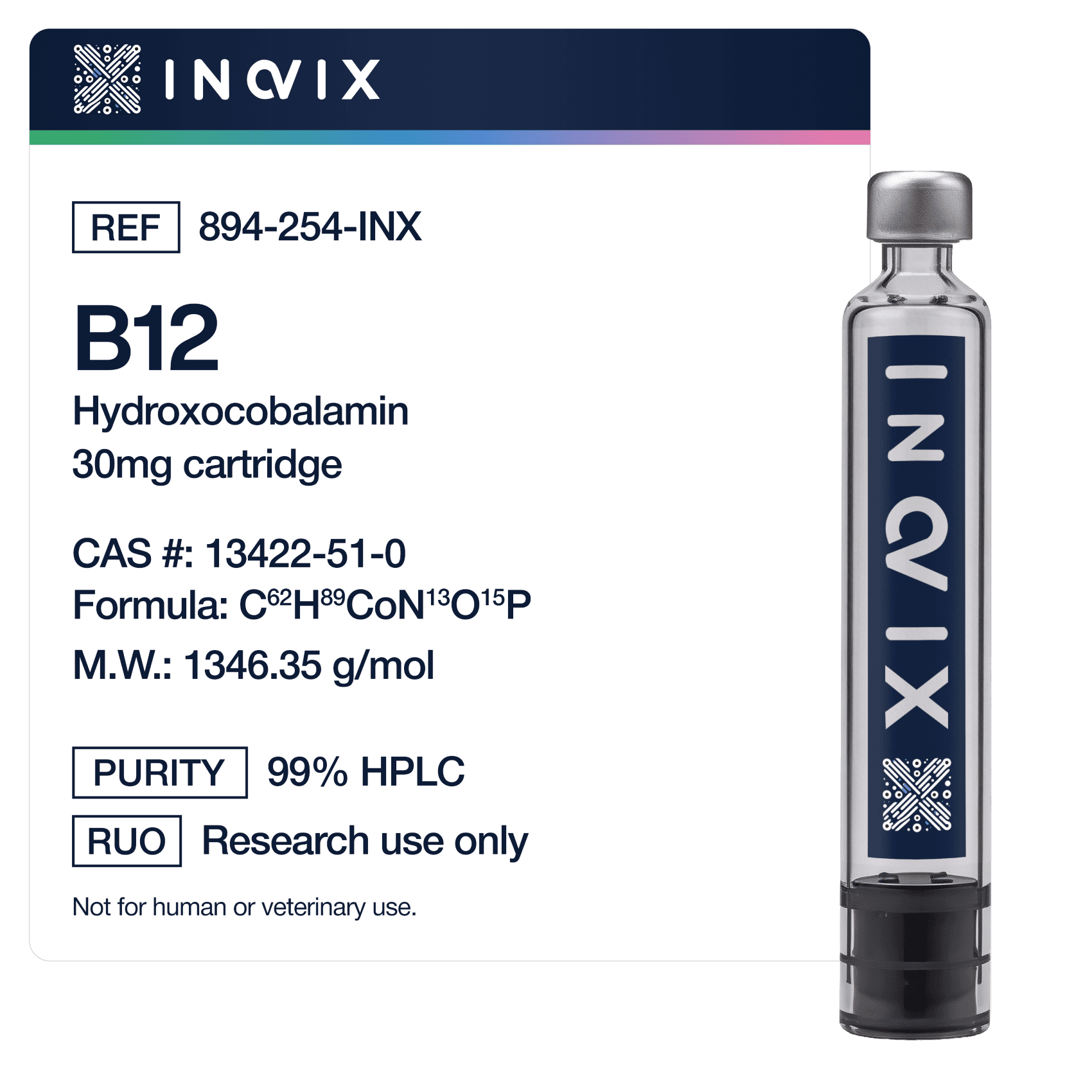
Hydroxocobalamin B12: Overview
Hydroxocobalamin is one of the principal cobalamin forms used for vitamin B12 replacement and is also the active ingredient in high-dose injectable preparations used for cyanide poisoning. Its central cobalt atom can bind different upper axial ligands; in hydroxocobalamin, that ligand is a hydroxo or aquo-related group. This ligand can be exchanged for cyanide, forming cyanocobalamin, a stable cobalamin species that is excreted mainly in urine. [2–6]
In normal metabolism, hydroxocobalamin is not the final coenzyme form. Instead, after uptake and intracellular processing, cobalamin is converted into the two active coenzyme forms: methylcobalamin, required by cytosolic methionine synthase, and adenosylcobalamin, required by mitochondrial methylmalonyl-CoA mutase. These two enzymatic systems connect vitamin B12 status to DNA synthesis, methylation, homocysteine metabolism, methylmalonic acid metabolism, myelin integrity, and mitochondrial substrate utilization. [7–11]
Hydroxocobalamin has a broader pharmacological profile than simple nutrient replacement. At high doses, it acts as a direct cyanide-binding antidote. In critical-care research, it is also studied as a vasopressor-sparing agent in refractory vasodilatory shock because of interactions with nitric oxide, nitric oxide synthase, soluble guanylate cyclase, and hydrogen sulfide pathways. [2–6,18–21]
Hydroxocobalamin B12: Structure
Hydroxocobalamin is a non-peptide cobalamin compound. It contains a central cobalt ion coordinated within a corrin ring, a lower ligand based on 5,6-dimethylbenzimidazole, and a hydroxo/aquo-type upper axial ligand. Public compound sources list hydroxocobalamin as CAS No. 13422-51-0, with molecular formula C62H89CoN13O15P and molecular weight approximately 1346.35–1346.4 g/mol. [1]
CAS No.: 13422-51-0
Molecular Formula: C62H89CoN13O15P
Molecular Weight: 1346.35–1346.4 g/mol
Length: Not applicable
Sequence: Not applicable
Compound Class: Cobalamin / corrinoid / organometallic cobalt complex
Synonyms: Hydroxocobalamin; Hydroxycobalamin; Vitamin B12a; Hydroxomin; Cyanokit
Common salt and formulated forms may differ. Hydroxocobalamin acetate is often listed as C64H91CoN13O16P with molecular weight around 1388.4 g/mol, while hydroxocobalamin hydrochloride is commonly represented as C62H89CoN13O15P·HCl with molecular weight around 1382.83 g/mol. Product specifications should therefore match the exact material form shown on the COA. [1,2]
Solubility: hydroxocobalamin is generally water-compatible, and injectable pharmaceutical products are supplied as lyophilized powder for solution. Solubility, concentration, and reconstitution behavior depend on the exact salt form, formulation, excipients, and batch conditions. [2–4]

Source: PubChem. Hydroxocobalamin compound entry, 2D structure image, CID 6433575.
Hydroxocobalamin B12: Cobalamin Chemistry
Hydroxocobalamin belongs to the broader cobalamin family, which includes cyanocobalamin, methylcobalamin, adenosylcobalamin, and hydroxocobalamin. All of these compounds share the cobalamin corrin-ring scaffold and central cobalt atom, but differ in the upper axial ligand attached to cobalt. [1,7,8]
This ligand difference has major biological and chemical consequences. Methylcobalamin and adenosylcobalamin are the coenzyme forms used directly by human enzymes, while hydroxocobalamin and cyanocobalamin are commonly used as precursor or replacement forms that must be processed intracellularly. The hydroxo/aquo ligand of hydroxocobalamin is especially important because it can be displaced by cyanide, producing cyanocobalamin. [2–8]
The central cobalt atom gives cobalamins their distinctive red color and redox-active behavior. Cobalamin chemistry involves multiple cobalt oxidation states and ligand-binding configurations, allowing vitamin B12 derivatives to participate in enzymatic radical chemistry, methyl transfer, ligand exchange, and detoxification chemistry. [7–11]

Source: Mucha P, Kuś F, Cysewski D, Smolenski RT, Tomczyk M. Vitamin B12 Metabolism: A Network of Multi-Protein Mediated Processes. International Journal of Molecular Sciences. 2024. Figure 1: skeletal formula of cobalamin with variable upper ligand. License: CC BY 4.0.
Hydroxocobalamin B12: Absorption and Transport
Vitamin B12 absorption is a sophisticated multistep process. Dietary cobalamin is released from food proteins, binds salivary and gastric haptocorrin, transfers to intrinsic factor in the small intestine, and is absorbed in the ileum through the cubam receptor complex. Once internalized into enterocytes, cobalamin can be transported into the bloodstream bound to transcobalamin, forming holotranscobalamin, the biologically active transport fraction available for cellular uptake. [7,9,10]
Hydroxocobalamin used as an injectable preparation bypasses the gastrointestinal absorption steps, but the same principles of cobalamin transport and cellular handling still matter once it circulates systemically. In blood and tissues, cobalamin distribution involves carrier proteins, tissue uptake through the transcobalamin receptor, lysosomal release, and intracellular conversion into active cofactor forms. [7–10]

Source: Kósa M, Galla Z, Lénárt I, et al. Vitamin B12 (Cobalamin): Its Fate from Ingestion to Metabolism with Particular Emphasis on Diagnostic Approaches of Acquired Neonatal/Infantile Deficiency Detected by Newborn Screening. Metabolites. 2022. Figure 1: route of cobalamin from intake to absorption. License: CC BY 4.0.

Source: Kósa M, Galla Z, Lénárt I, et al. Vitamin B12 (Cobalamin): Its Fate from Ingestion to Metabolism with Particular Emphasis on Diagnostic Approaches of Acquired Neonatal/Infantile Deficiency Detected by Newborn Screening. Metabolites. 2022. Figure 2: absorption, enterocyte transport, and distribution of cobalamin. License: CC BY 4.0.
Hydroxocobalamin B12: Intracellular Cobalamin Processing
After cellular uptake, cobalamin is released from transcobalamin inside lysosomes and exported into the cytosol through the LMBD1–ABCD4 lysosomal cobalamin transport system. From there, cobalamin is processed by intracellular trafficking proteins including MMACHC and MMADHC, which direct the molecule toward either cytosolic methylcobalamin production or mitochondrial adenosylcobalamin production. [7–10]
This intracellular processing step is essential because hydroxocobalamin itself must be converted into active coenzymes. In the cytosol, cobalamin is converted into methylcobalamin for methionine synthase. In mitochondria, cobalamin is converted into adenosylcobalamin for methylmalonyl-CoA mutase. Defects in this pathway cause characteristic biochemical disturbances, especially elevations in homocysteine, methylmalonic acid, or both. [7–11]

Source: Kósa M, Galla Z, Lénárt I, et al. Vitamin B12 (Cobalamin): Its Fate from Ingestion to Metabolism with Particular Emphasis on Diagnostic Approaches of Acquired Neonatal/Infantile Deficiency Detected by Newborn Screening. Metabolites. 2022. Figure 3: intracellular cobalamin processing into methylcobalamin and adenosylcobalamin pathways. License: CC BY 4.0.
Hydroxocobalamin B12: Methionine Synthase and One-Carbon Metabolism
One of the two human cobalamin-dependent enzymes is methionine synthase, a cytosolic enzyme that requires methylcobalamin. Methionine synthase transfers a methyl group from 5-methyltetrahydrofolate to homocysteine, producing methionine and regenerating tetrahydrofolate. This reaction links vitamin B12 to folate metabolism, DNA synthesis, methylation capacity, and homocysteine control. [7–11]
When cobalamin-dependent methionine synthase activity is impaired, homocysteine accumulates and methylation biology is disrupted. This is one of the biochemical explanations for the hematologic and neurologic consequences of vitamin B12 deficiency. Adequate cobalamin processing supports methylation chemistry, methionine regeneration, and normal folate-cycle function. [7–11]
In this context, hydroxocobalamin functions as a biologically useful precursor form that can enter the intracellular cobalamin processing network and support methylcobalamin-dependent methionine synthase activity after conversion. [7–11]
Hydroxocobalamin B12: Methylmalonyl-CoA Mutase and Mitochondrial Metabolism
The second human cobalamin-dependent enzyme is methylmalonyl-CoA mutase, a mitochondrial enzyme that requires adenosylcobalamin. This enzyme converts L-methylmalonyl-CoA to succinyl-CoA, connecting vitamin B12 to metabolism of odd-chain fatty acids, branched-chain amino acids, propionate, and mitochondrial energy pathways. [7–11]
When adenosylcobalamin-dependent methylmalonyl-CoA mutase activity is impaired, methylmalonic acid rises. Elevated methylmalonic acid is therefore a key functional marker of impaired intracellular cobalamin utilization. Hydroxocobalamin, after conversion through the mitochondrial cobalamin-processing pathway, supports this adenosylcobalamin-dependent reaction. [7–11]
This mitochondrial pathway is one reason vitamin B12 deficiency can affect tissues with high metabolic demand, including nervous system tissues. It also explains why cobalamin research spans hematology, neurology, mitochondrial metabolism, and inborn metabolic disorders. [7–11]
Hydroxocobalamin B12: Vitamin B12 Deficiency Research
Hydroxocobalamin is widely used in the treatment and study of vitamin B12 deficiency. B12 deficiency can produce megaloblastic anemia, cytopenias, neuropathy, cognitive changes, subacute combined degeneration of the spinal cord, fatigue, glossitis, and developmental complications in infants. Biochemically, deficiency often manifests through elevated methylmalonic acid, elevated homocysteine, and reduced active cobalamin availability. [7–12]
Hydroxocobalamin is especially important because it is a physiologic cobalamin form with strong clinical utility as an injectable replacement form. Compared with cyanocobalamin, hydroxocobalamin is often favored in several clinical settings because it avoids introducing cyanide as the upper ligand and is highly effective for replenishing cobalamin stores. [7–12]
Deficiency may result from poor intake, impaired gastric release, intrinsic-factor deficiency, ileal disease or resection, drug effects, nitrous oxide exposure, genetic transport defects, or intracellular cobalamin-processing disorders. Hydroxocobalamin therapy is especially relevant when absorption is impaired or when intracellular processing disorders require parenteral cobalamin exposure. [7–12]

Source: Kósa M, Galla Z, Lénárt I, et al. Vitamin B12 (Cobalamin): Its Fate from Ingestion to Metabolism with Particular Emphasis on Diagnostic Approaches of Acquired Neonatal/Infantile Deficiency Detected by Newborn Screening. Metabolites. 2022. Figure 4: secondary causes of vitamin B12 deficiency. License: CC BY 4.0.
Hydroxocobalamin B12: Inborn Errors of Cobalamin Metabolism
Hydroxocobalamin has a major role in inherited intracellular cobalamin disorders, especially conditions affecting conversion to methylcobalamin and adenosylcobalamin. These disorders include complementation groups such as cblC, cblD, cblF, cblJ, cblE, cblG, cblA, and cblB, each affecting different steps of cobalamin transport, trafficking, reduction, methylation, or adenosylation. [9,12–14]
The most recognized condition in this group is cblC disease, commonly associated with combined methylmalonic acidemia and homocystinuria. In these disorders, injectable hydroxocobalamin is a core therapy because it provides high systemic availability of a cobalamin form that can partially support intracellular processing and improve metabolic control. [12–14]
High-dose hydroxocobalamin has been reported to improve biochemical markers and neuropsychiatric outcomes in late-onset cblC disease, and dose-escalation approaches have been studied in patients with persistent metabolic abnormalities. This makes hydroxocobalamin a central molecule not only in general B12 replacement but also in precision treatment of intracellular cobalamin-processing defects. [12–14]
Hydroxocobalamin B12: Cyanide Detoxification
Hydroxocobalamin is one of the most important cyanide antidotes because its cobalt center binds cyanide directly. Each hydroxocobalamin molecule can bind one cyanide ion by replacing the hydroxo ligand coordinated to trivalent cobalt, forming cyanocobalamin. The resulting cyanocobalamin is then excreted primarily in urine. [2–6,15–17]
This mechanism is direct and chemically efficient. Cyanide poisoning disrupts cellular respiration by inhibiting cytochrome c oxidase and blocking mitochondrial oxygen utilization. Hydroxocobalamin reduces free cyanide by converting it into a stable cobalamin-bound form, helping preserve cellular respiration and ATP production when administered promptly. [2–6,15–17]
Hydroxocobalamin is especially relevant in smoke-inhalation-associated cyanide poisoning, where victims may have combined carbon monoxide exposure, hypoxia, burns, and inhaled hydrogen cyanide. Clinical studies and countermeasure guidance support hydroxocobalamin as a mechanistically sound and widely used antidote because it does not induce methemoglobinemia and can be administered empirically when cyanide poisoning is suspected. [3–6,15–17]
Hydroxocobalamin B12: Pharmacokinetics in Cyanide Antidote Use
In high-dose cyanide-antidote use, hydroxocobalamin is administered in gram quantities, far above nutritional replacement doses. Product labeling and clinical pharmacology data describe prolonged systemic exposure to cobalamin species after infusion, with excretion mainly through urine. The formation of cyanocobalamin after cyanide binding is central to the detoxification pathway. [2–6]
High-dose hydroxocobalamin commonly produces red discoloration of skin, plasma, and urine because the molecule is intensely colored. This is expected from the cobalamin chromophore and can interfere with some colorimetric laboratory assays. [2–6,18]
The pharmacological profile is therefore dual-purpose: at replacement doses, hydroxocobalamin supports cobalamin status; at antidote doses, it functions as a high-capacity cyanide-binding agent. [2–6,15–17]
Hydroxocobalamin B12: Nitric Oxide, Hydrogen Sulfide, and Vasoplegia Research
Hydroxocobalamin has attracted increasing interest in critical-care research because high-dose administration can increase blood pressure and reduce vasopressor requirements in some vasodilatory shock states. Mechanistically, this is linked to scavenging or modulation of nitric oxide and hydrogen sulfide, both of which contribute to vasodilation through vascular smooth muscle relaxation and related signaling pathways. [18–21]
In vasoplegic shock after cardiac surgery, liver transplantation, septic shock, and drug-induced vasodilation, hydroxocobalamin has been studied as a rescue or adjunct therapy. The proposed mechanisms include nitric oxide scavenging, nitric oxide synthase inhibition, guanylate cyclase pathway modulation, and hydrogen sulfide binding or suppression. [18–21]
The clinical evidence is still developing, but multiple case series, retrospective studies, and reviews report hemodynamic improvement in selected patients with refractory vasoplegia. Recent cardiac-surgery and septic-shock literature suggests that response durability varies by patient and setting, but the compound remains an important non-catecholamine vasopressor-sparing research candidate. [18–21]
Hydroxocobalamin B12: Hydroxo-B12 vs Cyano-B12
Hydroxocobalamin and cyanocobalamin are both vitamin B12 forms, but they are not chemically identical. Hydroxocobalamin carries a hydroxo/aquo-type ligand, while cyanocobalamin carries a cyanide ligand. Both can enter the intracellular cobalamin-processing pathway, but ligand chemistry can influence conversion, distribution, binding behavior, and formulation properties. [1,7,8,22]
Animal studies have compared tissue distribution of hydroxo-B12 and cyano-B12 after oral intake. These studies suggest that different B12 forms can show different distribution patterns across tissues, reinforcing the idea that cobalamin form can matter in experimental nutrition and metabolism research. [22]
Hydroxocobalamin is also central to cyanide antidote use precisely because its ligand can be displaced by cyanide. Cyanocobalamin is the product of that detoxification reaction, not the antidotal starting point for cyanide binding. [2–6,15–17]

Source: Greibe E, Nymark O, Fedosov SN, Heegaard CW, Nexo E. Differences in Tissue Distribution of Cyano–B12 and Hydroxo–B12 One Week after Oral Intake: An Experimental Study in Male Wistar Rats. Nutrients. 2018. Figure 2: tissue distribution of radiolabeled B12 after hydroxo-B12 or cyano-B12 intake. License: CC BY 4.0.
Hydroxocobalamin B12: Cellular Uptake and Conversion Kinetics
Recent cellular work has compared the uptake and conversion of cyanocobalamin and aquo/hydroxocobalamin forms. These studies are important because the functional value of a cobalamin form is not determined only by its chemical structure in a vial; it also depends on binding to carrier proteins, receptor-mediated uptake, intracellular liberation, ligand removal, and conversion to the two active coenzymes. [23]
Hydroxocobalamin is often discussed together with aquocobalamin because the hydroxo/aquo forms interconvert depending on pH and solution environment. In biological systems, this makes hydroxocobalamin part of a broader labile-ligand cobalamin pool that can be processed toward active cofactor production. [7,8,23]
Cellular uptake kinetics, carrier binding, and intracellular conversion are therefore central to understanding hydroxocobalamin as a functional B12 source. These processes also explain why inherited processing defects can cause severe disease even when serum B12 levels are not straightforwardly low. [9,12–14,23]
Hydroxocobalamin B12: Analytical and Product-Quality Considerations
Hydroxocobalamin is an intensely colored red chromophore. This property is useful for recognition and analytical work, but it can also cause interference in colorimetric laboratory assays after high-dose administration. In clinical settings after cyanide antidote dosing, interference may affect some blood chemistry measurements, co-oximetry, and other photometric assays. [2–6,18]
For chemical wholesaler and research-product contexts, the most important analytical considerations are identity, salt form, water content, purity, light sensitivity, and batch-specific assay data. Hydroxocobalamin forms may be listed as free base, acetate, hydrochloride, sulfate, or other formulation-specific materials, and these forms have different formula weights. [1,2]
Product pages should therefore distinguish clearly between:
Hydroxocobalamin / Vitamin B12a
CAS 13422-51-0, formula C62H89CoN13O15P, MW 1346.35–1346.4 g/mol
Hydroxocobalamin acetate
Formula commonly listed as C64H91CoN13O16P, MW 1388.4 g/mol
Hydroxocobalamin hydrochloride
CAS commonly listed as 58288-50-9, formula C62H89CoN13O15P·HCl, MW 1382.83 g/mol
Final product specifications should always follow the exact form and batch COA. [1,2]
Hydroxocobalamin B12: Summary
Hydroxocobalamin B12 is a non-peptide cobalt-containing cobalamin compound with a broad and unusually important research and clinical profile. Its strongest roles are in vitamin B12 replacement, intracellular cobalamin metabolism, methylcobalamin and adenosylcobalamin coenzyme production, cyanide detoxification, inborn cobalamin-processing disorders, and critical-care vasoplegia research. [1–23]
Its defining chemical feature is the cobalt-bound hydroxo/aquo ligand, which gives hydroxocobalamin both metabolic flexibility and cyanide-binding capacity. In normal biology, it enters the cobalamin trafficking network and supports production of methylcobalamin and adenosylcobalamin. At high doses, it directly binds cyanide to form cyanocobalamin. In critical-care research, it is studied for modulation of nitric oxide and hydrogen sulfide pathways involved in refractory vasodilation. [1–23]
For a chemical wholesaler product page, the most accurate positioning is: Hydroxocobalamin B12 is a water-compatible vitamin B12a cobalamin compound used in research on B12 metabolism, cobalamin-dependent enzymes, cyanide binding, inherited cobalamin disorders, and redox/vasodilatory signaling.
Selected References
PubChem. Hydroxocobalamin compound entry. Molecular formula, molecular weight, synonyms, and chemical identifiers.
FDA. CYANOKIT® (hydroxocobalamin for injection) prescribing information. Mechanism, pharmacology, pharmacokinetics, and cyanide-binding description.
HHS CHEMM. Hydroxocobalamin Medical Countermeasure Database. Cyanide antidote mechanism and emergency countermeasure information.
EMA. Cyanokit EPAR scientific discussion. Hydroxocobalamin mechanism and cyanide-binding rationale.
Borron SW, Baud FJ, Barriot P, Imbert M, Bismuth C. Prospective study of hydroxocobalamin for acute cyanide poisoning in smoke inhalation. Annals of Emergency Medicine. 2007.
Mégarbane B. Hydroxocobalamin as first-line antidote to treat cyanide poisoning in fire smoke inhalation: an additional step for efficacy evidence. Emergencias. 2010.
Kósa M, Galla Z, Lénárt I, Baráth Á, Grecsó N, Rácz G, Bereczki C, Monostori P. Vitamin B12 (Cobalamin): Its Fate from Ingestion to Metabolism with Particular Emphasis on Diagnostic Approaches of Acquired Neonatal/Infantile Deficiency Detected by Newborn Screening. Metabolites. 2022.
Mucha P, Kuś F, Cysewski D, Smolenski RT, Tomczyk M. Vitamin B12 Metabolism: A Network of Multi-Protein Mediated Processes. International Journal of Molecular Sciences. 2024.
Sloan JL, Carrillo N, Adams D, Venditti CP. Disorders of Intracellular Cobalamin Metabolism. GeneReviews. Updated 2021.
Mascarenhas R, Ruetz M, McDevitt L, et al. Methionine synthase and methylmalonyl-CoA mutase. 2022 review.
Banerjee R, Gouda H, Pillay S. Redox-Linked Coordination Chemistry Directs Vitamin B12 Trafficking. Accounts of Chemical Research. 2021.
Higashimoto T, et al. High-dose hydroxocobalamin achieves rapid and sustainable metabolic control and improvement in neuropsychiatric outcomes in adults with late-onset cblC disease. 2019.
GeneReviews. Disorders of Intracellular Cobalamin Metabolism. Treatment and pathway discussion including hydroxocobalamin management.
Visualize/JoVE clinical case material. Disorder of intracellular cobalamin metabolism: importance of rapid diagnosis illustrated by early-onset methylmalonic aciduria and homocystinuria cobalamin C type.
Meillier A, Heller C. Acute Cyanide Poisoning: Hydroxocobalamin and Sodium Thiosulfate Treatments with Two Outcomes following One Exposure Event. 2015.
StatPearls / NCBI Bookshelf. Hydroxocobalamin. Cyanide-binding mechanism and clinical use summary.
Utah Poison Control. So Long, Cyanide. 2025 overview of hydroxocobalamin cyanide binding and smoke-inhalation relevance.
Methodist DeBakey Cardiovascular Journal. Vasoplegia: A Review. Discussion of hydroxocobalamin, nitric oxide, guanylate cyclase, and vasoplegia.
Zakaria L, et al. Hydroxocobalamin for vasoplegia in cardiac surgery. British Journal of Anaesthesia. 2025.
Sacco AJ, Cunningham CA, Kosiorek HE, Sen A. Hydroxocobalamin in Refractory Septic Shock: A Retrospective Case Series. Critical Care Explorations. 2021.
UIC Drug Information Group. Is intravenous hydroxocobalamin an effective treatment for vasoplegia-associated shock? 2024.
Greibe E, Nymark O, Fedosov SN, Heegaard CW, Nexo E. Differences in Tissue Distribution of Cyano–B12 and Hydroxo–B12 One Week after Oral Intake: An Experimental Study in Male Wistar Rats. Nutrients. 2018.
Fedosov SN, Nexo E, Heegaard CW. Kinetics of Cellular Cobalamin Uptake and Conversion: Comparison of Aquo/Hydroxocobalamin to Cyanocobalamin. Nutrients. 2024.