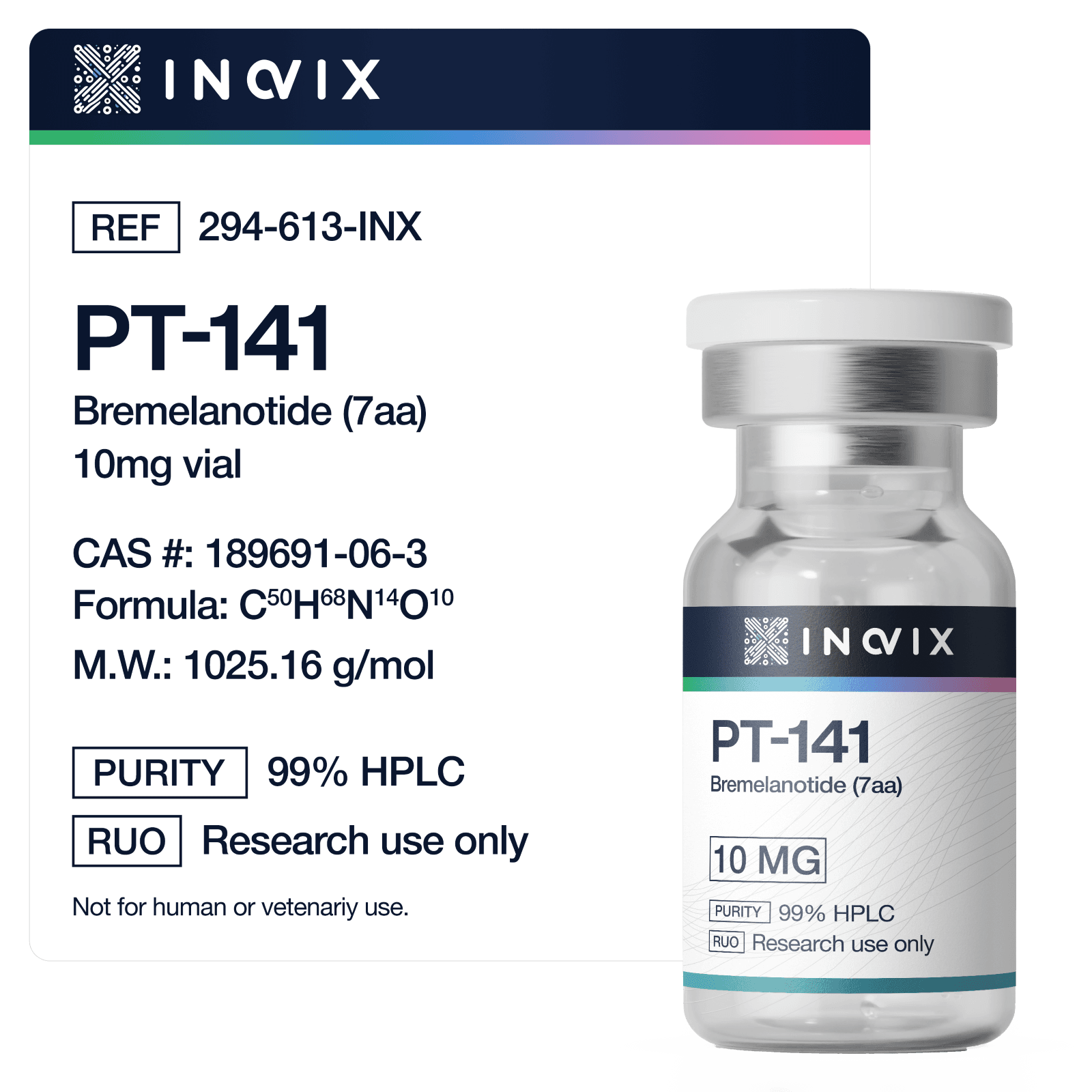
PT-141: Overview
PT-141 is a melanocortin receptor agonist and α-MSH-derived cyclic peptide. It was originally investigated under the name PT-141 and later developed clinically as bremelanotide, the active ingredient in Vyleesi. The FDA-approved drug product is used for premenopausal women with acquired, generalized HSDD, characterized by low sexual desire that causes marked distress or interpersonal difficulty and is not due to a coexisting medical or psychiatric condition, relationship problems, or medication/substance effects. [2,4]
The core research interest around PT-141 is its ability to modulate sexual desire and arousal through central melanocortin signaling. This separates it from phosphodiesterase-5 inhibitors, which primarily act through peripheral nitric-oxide/cGMP-mediated vascular pathways. PT-141 has been studied in women with HSDD, women with female sexual arousal disorder, healthy male subjects, men with erectile dysfunction, and sildenafil nonresponders. [4–14]
PT-141’s clinical and mechanistic literature is unusually strong for a peptide in the sexual-function field. It includes phase 3 trials, long-term open-label extension data, human fMRI mechanistic work, pharmacokinetic data, dose-finding trials, and early male sexual-function studies. [4–17]
PT-141: Structure
PT-141 is a 7-amino-acid cyclic peptide. Public chemical databases list bremelanotide as CAS No. 189691-06-3, with molecular formula C50H68N14O10 and molecular weight approximately 1025.16–1025.18 g/mol. Bremelanotide acetate is listed separately, commonly as CAS No. 1607799-13-2, with acetate-dependent formula and molecular weight values. [1,3]
CAS No.: 189691-06-3
Molecular Formula: C50H68N14O10
Molecular Weight: 1025.16–1025.18 g/mol
Length: 7 AA
Sequence: Ac-Nle-cyclo[Asp-His-D-Phe-Arg-Trp-Lys]-OH
Sequence Description: Acetylated cyclic heptapeptide α-MSH analogue
Synonyms: PT-141; Bremelanotide; Bremelanotide acetate; Vyleesi
Bremelanotide is structurally related to melanocortin peptides and is often described as a cyclic lactam analogue of α-MSH. The peptide contains an N-terminal acetylated norleucine, a D-Phe residue, and a cyclic structure formed through the Asp/Lys side-chain lactam. This macrocyclic design supports melanocortin receptor agonist activity and improves biological stability relative to linear melanocortin fragments. [1,3]
Solubility is form-dependent. FDA chemistry review material describes bremelanotide acetate as freely soluble in water, methanol, and DMSO, soluble in ethanol, and insoluble in acetone and acetonitrile. Final reconstitution and solubility specifications should follow the exact salt form and batch COA. [3]

Source: PubChem. Bremelanotide compound entry, 2D structure image, CID 9941379.
PT-141: Melanocortin Receptor Pharmacology
PT-141 acts within the melanocortin receptor family, especially receptors involved in central sexual behavior, arousal, appetite, satiety, and neuroendocrine regulation. It is commonly described as a melanocortin receptor agonist with particular relevance to MC4R and MC3R, while broader melanocortin receptor activity across the family contributes to its biological profile. [8,15–17]
The melanocortin receptor family consists of five major receptor subtypes: MC1R, MC2R, MC3R, MC4R, and MC5R. MC1R is strongly associated with pigmentation and melanocyte biology, MC2R with ACTH/adrenal signaling, and MC3R/MC4R with central metabolic and neurobehavioral pathways. MC4R is especially important for PT-141 because of its central role in sexual arousal circuitry, appetite regulation, reward processing, and hypothalamic-limbic signaling. [8,15–17]
The central melanocortin system is closely tied to both reproductive behavior and energy balance. In sexual-function research, PT-141 is generally positioned as a centrally acting peptide that influences desire and arousal through melanocortin-sensitive brain pathways rather than through direct genital vasodilation. [8,15–17]
PT-141: Central Sexual Desire and Arousal Signaling
PT-141 is best understood as a peptide that acts on the brain component of sexual response. Sexual desire and arousal depend on a balance between excitatory and inhibitory networks, including dopamine, norepinephrine, melanocortin, oxytocin, serotonin, opioid, endocannabinoid, and prolactin-related signaling. In HSDD, neuroimaging and clinical models suggest that excessive top-down cognitive monitoring and self-referential processing may interfere with normal sexual response pathways. [8,15]
Bremelanotide’s mechanistic role is to activate melanocortin signaling and increase responsiveness within brain networks involved in sexual motivation, imagery, attention, and sensory-emotional processing. The most direct human mechanistic evidence comes from fMRI research showing that MC4R agonism altered activity in the cerebellum, supplementary motor area, secondary somatosensory cortex, amygdala, insula, and thalamus during erotic-stimulus processing in women with HSDD. [8]

Source: Thurston L, Hunjan T, Mills EG, et al. Melanocortin 4 receptor agonism enhances sexual brain processing in women with hypoactive sexual desire disorder. Journal of Clinical Investigation. 2022. Graphical abstract: study design and proposed neural mechanism of MC4R agonism in HSDD.
PT-141: Human fMRI Research in HSDD
One of the strongest mechanistic studies of PT-141 was a randomized, double-blind, placebo-controlled crossover fMRI study in 31 premenopausal heterosexual women with HSDD. Participants received bremelanotide or placebo on separate study days and completed psychometric, hormonal, and neuroimaging assessments during erotic-stimulus exposure. [8]

Source: Thurston L, Hunjan T, Mills EG, et al. Melanocortin 4 receptor agonism enhances sexual brain processing in women with hypoactive sexual desire disorder. Journal of Clinical Investigation. 2022. Figure 1: experimental protocol for randomized crossover fMRI study.
In this study, a significantly larger number of participants reported increased sexual desire during the 24 hours after bremelanotide administration compared with placebo. The study also showed that MC4R agonism enhanced sexual brain processing rather than simply producing a nonspecific attention effect. [8]

Source: Thurston L, Hunjan T, Mills EG, et al. Melanocortin 4 receptor agonism enhances sexual brain processing in women with hypoactive sexual desire disorder. Journal of Clinical Investigation. 2022. Figure 3: more participants reported increased sexual desire after MC4R agonist administration than after placebo.
During the first fMRI scan, MC4R agonism increased activity in the right cerebellum, particularly lobules V and VI, while deactivating the secondary somatosensory cortex bilaterally. This pattern supports a model in which PT-141 increases sensory-emotional engagement while reducing excessive self-monitoring or higher-level inhibition. [8]

Source: Thurston L, Hunjan T, Mills EG, et al. Melanocortin 4 receptor agonism enhances sexual brain processing in women with hypoactive sexual desire disorder. Journal of Clinical Investigation. 2022. Figure 4: MC4R agonism enhances cerebellar activity and deactivates secondary somatosensory cortex in response to erotic stimuli.
During the second fMRI scan, MC4R agonism increased activation of the supplementary motor area, a region involved in motor imagery, attention to action, and internal simulation of behavior. In sexual-arousal neuroimaging, this region is often linked with sexual motor imagery and attentional appraisal of erotic stimuli. [8]

Source: Thurston L, Hunjan T, Mills EG, et al. Melanocortin 4 receptor agonism enhances sexual brain processing in women with hypoactive sexual desire disorder. Journal of Clinical Investigation. 2022. Figure 5: MC4R agonism activates the supplementary motor area in response to erotic stimuli.
Functional connectivity analysis showed that bremelanotide prevented the reduction in connectivity between the amygdala and insula that occurred under placebo during erotic-stimulus exposure. The amygdala, insula, and thalamus are key nodes in emotional salience, sensory integration, interoception, and sexual-response processing. [8]

Source: Thurston L, Hunjan T, Mills EG, et al. Melanocortin 4 receptor agonism enhances sexual brain processing in women with hypoactive sexual desire disorder. Journal of Clinical Investigation. 2022. Figure 6: MC4R agonism prevents reduced amygdala–insula connectivity in response to erotic stimuli.
Taken together, the fMRI data support PT-141 as a peptide acting through central sexual-processing networks, including changes in sensory integration, sexual imagery, limbic connectivity, and reduced top-down self-monitoring. This gives bremelanotide one of the clearest mechanistic neuroimaging profiles among sexual-function peptides. [8]
PT-141: Female Sexual Desire Disorder and Phase 3 RECONNECT Trials
The pivotal clinical evidence for bremelanotide comes from two identical phase 3 trials known as RECONNECT Study 301 and RECONNECT Study 302. These were randomized, double-blind, placebo-controlled, multicenter trials in premenopausal women with acquired, generalized HSDD. Bremelanotide 1.75 mg was administered subcutaneously as needed for 24 weeks. [4]
The co-primary endpoints were change from baseline to end of study in the Female Sexual Function Index desire domain (FSFI-D) and change in distress related to low sexual desire using Female Sexual Distress Scale–Desire/Arousal/Orgasm item 13 (FSDS-DAO Q13). Across both trials, bremelanotide produced statistically significant improvements in sexual desire and statistically significant reductions in distress related to low sexual desire compared with placebo. [4]
In the integrated RECONNECT population, bremelanotide improved FSFI-D and FSDS-DAO outcomes over the 24-week treatment period. The trial also showed supportive improvements across several secondary measures related to sexual arousal, satisfaction, and distress. [4]

Source: Kingsberg SA, Clayton AH, Portman D, et al. Bremelanotide for the Treatment of Hypoactive Sexual Desire Disorder: Two Randomized Phase 3 Trials. Obstetrics & Gynecology. 2019. Figure 1: co-primary endpoints and dynamic-anchor response over the phase 3 core studies.
The phase 3 trials also evaluated satisfying sexual events. The FDA label and trial paper reported that the number of satisfying sexual events did not show the same statistically significant separation as the desire and distress endpoints. This is clinically meaningful because it shows that bremelanotide’s strongest signal is specifically in desire and distress reduction, rather than simply increasing event counts. [2,4]

Source: Kingsberg SA, Clayton AH, Portman D, et al. Bremelanotide for the Treatment of Hypoactive Sexual Desire Disorder: Two Randomized Phase 3 Trials. Obstetrics & Gynecology. 2019. Figure 2: percentage of sexual encounters reported as satisfying sexual events.
Supportive secondary endpoints favored bremelanotide across several measures, including desire, arousal, satisfaction, and distress-related outcomes. This broader endpoint pattern supports the peptide’s role in a central desire/arousal network rather than a narrow single-question effect. [4]

Source: Kingsberg SA, Clayton AH, Portman D, et al. Bremelanotide for the Treatment of Hypoactive Sexual Desire Disorder: Two Randomized Phase 3 Trials. Obstetrics & Gynecology. 2019. Figure 3: forest plot of supportive secondary efficacy endpoints in the phase 3 studies.
PT-141: Long-Term Clinical Extension Data
The RECONNECT program also included a 52-week open-label extension following the 24-week double-blind core phase. Women who completed the core phase could continue into longer-term bremelanotide treatment. [5]
The long-term extension supported sustained efficacy and a consistent safety profile during longer exposure. Participants continued to show improvements in HSDD-related symptoms, with the most common adverse events remaining primarily tolerability-related. This long-term dataset is important because PT-141 is used on demand rather than daily, and the extension allowed observation across a much longer real-use period than the pivotal 24-week core studies. [5]
The long-term data reinforce the clinical positioning of bremelanotide as an as-needed, centrally acting melanocortin peptide for desire-related sexual dysfunction rather than a daily neuromodulator or peripheral vascular agent. [5]
PT-141: Dose-Finding Research in Premenopausal Women
Before the phase 3 RECONNECT program, bremelanotide was studied in a randomized, placebo-controlled dose-finding trial in premenopausal women with female sexual dysfunction. In that trial, self-administered, as-needed subcutaneous bremelanotide was evaluated across fixed dose levels. [6]
The dose-finding program helped define 1.75 mg subcutaneous dosing as the later clinical development dose. It supported the transition from earlier intranasal PT-141 work toward the subcutaneous formulation used in pivotal HSDD trials. [6]
This dose-finding step is important because it established that bremelanotide’s therapeutic window was not simply theoretical; it could be operationalized into a patient-administered, on-demand treatment model for premenopausal women. [6]
PT-141: Early Female Sexual Arousal Research
Earlier female sexual-function studies focused on female sexual arousal disorder rather than the later HSDD indication. In a preliminary study in premenopausal women with sexual arousal disorder, intranasal bremelanotide produced improvements in subjective sexual response measures. [7]
These earlier data helped establish the clinical hypothesis that a melanocortin receptor agonist could influence female sexual function through central pathways. The later HSDD program refined the indication and endpoint structure toward low desire and associated distress, but the early arousal literature remains an important part of PT-141’s development history. [7]
PT-141: Male Erectile Function Research
PT-141 was also investigated in men with erectile dysfunction before bremelanotide’s final clinical development pathway centered on HSDD in premenopausal women. Early studies evaluated both intranasal and subcutaneous PT-141 in healthy male subjects and in men with erectile dysfunction, including men with inadequate response to sildenafil. [10–14]
In healthy male subjects and men with erectile dysfunction, PT-141 produced measurable erectile responses assessed by RigiScan and related objective measures. In one study, subcutaneous PT-141 produced statistically significant erectile responses at higher tested doses, including in men with inadequate response to sildenafil. [10]
Intranasal PT-141 was also evaluated in men with mild-to-moderate erectile dysfunction, where it produced erectile responses compared with placebo and was generally well tolerated in the studied dose ranges. Additional work evaluated PT-141 in combination with sildenafil, supporting the concept that central melanocortin activation could complement peripheral PDE5 inhibition. [11–13]
Later research specifically examined intranasal bremelanotide in men with erectile dysfunction who did not respond to sildenafil. These studies remain important historically because they demonstrated that melanocortin receptor agonism could influence male sexual response independently of classical peripheral vasodilator pharmacology. [14]
PT-141: Pharmacokinetics and Clinical Pharmacology
The FDA label for bremelanotide reports a median Tmax of approximately 1 hour after subcutaneous administration, with absolute bioavailability of about 100%. The site of subcutaneous administration, abdomen versus thigh, had no significant effect on systemic exposure. [2]
After a single subcutaneous administration, bremelanotide has a mean terminal half-life of approximately 2.7 hours, with a reported range of 1.9 to 4.0 hours. Human serum protein binding is approximately 21%, and mean apparent volume of distribution is approximately 25.0 ± 5.8 L. [2]
As a cyclic heptapeptide, bremelanotide is primarily metabolized through hydrolysis of amide bonds in the peptide. After radiolabeled administration, approximately 64.8% of total radioactivity was recovered in urine and 22.8% in feces. [2]
The label also notes that bremelanotide may slow gastric motility and can reduce the rate and extent of absorption of some orally administered medications. This is consistent with melanocortin receptor activity in pathways that influence appetite, satiety, and autonomic gastrointestinal function. [2]
PT-141: Safety and Tolerability Profile
Across clinical studies, the most common bremelanotide adverse events were nausea, flushing, and headache, with most treatment-emergent adverse events described as mild or moderate in intensity. [2,4,5]
The FDA label also describes a transient increase in blood pressure and decrease in heart rate after dosing, usually resolving within approximately 12 hours post-dose. This hemodynamic profile is one reason the approved product has specific cardiovascular-use restrictions. [2]
Hyperpigmentation can occur with melanocortin receptor agonists because melanocortin signaling can engage melanocyte biology through MC1R-related pathways. In clinical use, focal hyperpigmentation has been reported, particularly with higher cumulative exposure. [2]
The label reports that a 20 mg intranasal dose did not prolong the QTc interval to a clinically relevant extent, and alcohol did not significantly alter the pharmacokinetic profile of bremelanotide in the study described in the label. [2]
PT-141: Regulatory and Clinical Use Profile
Bremelanotide was approved in the United States in 2019 as Vyleesi. The approved clinical formulation is a 1.75 mg / 0.3 mL subcutaneous autoinjector used on an as-needed basis. In the phase 3 program, most patients used it approximately two to three times per month and no more than once weekly. [2,4]
The approved indication is specific: premenopausal women with acquired, generalized HSDD characterized by low sexual desire that causes marked distress or interpersonal difficulty and is not caused by other medical, psychiatric, relational, or medication/substance factors. [2]
This regulatory status makes PT-141 / bremelanotide notable among research peptides: it is not only a preclinical or experimental compound, but a clinically approved melanocortin peptide with a defined indication, pivotal efficacy trials, and mechanistic neuroimaging support. [2,4,8]
PT-141: Relationship to α-MSH and Melanocortin Peptide Design
PT-141 belongs to the broader class of α-MSH-derived melanocortin peptides. The melanocortin peptide family has been studied for pigmentation, appetite, satiety, sexual behavior, inflammation, and neuroendocrine regulation. [15–17]
Bremelanotide’s macrocyclic heptapeptide structure was designed to retain melanocortin receptor agonist activity while improving stability and central neurobehavioral activity. The presence of D-Phe and the lactam ring are important design elements frequently seen in potent melanocortin analogues. [1,15–17]
From a peptide-design perspective, PT-141 is a strong example of how a hormone-derived peptide fragment can be transformed into a clinically active macrocyclic research and therapeutic compound through selective amino-acid substitution, cyclization, and terminal modification. [1,15–17]
PT-141: Research Summary
PT-141 / bremelanotide is a cyclic heptapeptide melanocortin receptor agonist with a substantial research profile in sexual desire, central arousal processing, HSDD, female sexual arousal, male erectile function, and melanocortin neurobiology. [1–17]
Its strongest evidence base includes:
Central mechanism: fMRI evidence showing enhanced sexual brain processing, altered cerebellar and supplementary motor area activation, reduced secondary somatosensory cortex activity, and preserved amygdala–insula connectivity during erotic-stimulus exposure. [8]
Clinical efficacy: two phase 3 RECONNECT trials showing statistically significant improvements in sexual desire and reductions in distress related to low sexual desire in premenopausal women with acquired, generalized HSDD. [4]
Long-term data: a 52-week open-label extension supporting sustained efficacy and a consistent tolerability profile. [5]
Development history: earlier studies in female sexual arousal disorder and male erectile dysfunction supporting the broader sexual-function activity of the melanocortin peptide platform. [7,10–14]
Pharmacology: a centrally acting melanocortin peptide with clinically characterized pharmacokinetics, a short terminal half-life after subcutaneous dosing, and a defined FDA-approved formulation. [2]
PT-141 is therefore best positioned as a centrally acting melanocortin peptide for research on sexual motivation, desire, arousal circuitry, and neuroendocrine sexual-function signaling.
Selected References
PubChem. Bremelanotide compound entry, CID 9941379. Molecular formula, molecular weight, structure, identifiers, and synonyms.
FDA. VYLEESI® (bremelanotide injection) prescribing information. Pharmacokinetics, clinical studies, approved indication, dosing, safety, and product formulation.
FDA. Bremelanotide acetate chemistry review. Solubility, structural confirmation, and pharmaceutical-chemistry information for bremelanotide acetate.
Kingsberg SA, Clayton AH, Portman D, Williams LA, Krop J, Jordan R, Lucas J, Simon JA. Bremelanotide for the Treatment of Hypoactive Sexual Desire Disorder: Two Randomized Phase 3 Trials. Obstetrics & Gynecology. 2019;134(5):899–908.
Simon JA, Kingsberg SA, Portman D, Williams LA, Krop J, Jordan R, Lucas J, Clayton AH. Long-Term Safety and Efficacy of Bremelanotide for Hypoactive Sexual Desire Disorder. Obstetrics & Gynecology. 2019;134(5):909–917.
Clayton AH, Althof SE, Kingsberg S, et al. Bremelanotide for female sexual dysfunctions in premenopausal women: a randomized, placebo-controlled dose-finding trial. Women’s Health. 2016.
Diamond LE, Earle DC, Heiman JR, Rosen RC, Perelman MA, Harning R. An effect on the subjective sexual response in premenopausal women with sexual arousal disorder by bremelanotide (PT-141), a melanocortin receptor agonist. Journal of Sexual Medicine. 2006.
Thurston L, Hunjan T, Mills EG, Wall MB, Ertl N, Phylactou M, Muzi B, Patel B, Alexander EC, Suladze S, Modi M, Eng PC, Bassett PA, Abbara A, Goldmeier D, Comninos AN, Dhillo WS. Melanocortin 4 receptor agonism enhances sexual brain processing in women with hypoactive sexual desire disorder. Journal of Clinical Investigation. 2022;132(19):e152341.
Edinoff AN, Sanders NM, H. et al. Bremelanotide for Treatment of Female Hypoactive Sexual Desire. 2022 review.
Rosen RC, Diamond LE, Earle DC, et al. Evaluation of the safety, pharmacokinetics and pharmacodynamic effects of subcutaneously administered PT-141, a melanocortin receptor agonist, in healthy male subjects and in patients with an inadequate response to Viagra. International Journal of Impotence Research. 2004.
Diamond LE, Earle DC, Rosen RC, et al. Double-blind, placebo-controlled evaluation of the safety, pharmacokinetic properties and pharmacodynamic effects of intranasal PT-141, a melanocortin receptor agonist, in healthy males and patients with mild-to-moderate erectile dysfunction. International Journal of Impotence Research. 2004.
Diamond LE, Earle DC, Garcia WD, Spana C. Co-administration of low doses of intranasal PT-141, a melanocortin receptor agonist, and sildenafil to men with erectile dysfunction results in an enhanced erectile response. Urology. 2005.
Safarinejad MR, et al. Salvage of sildenafil failures with bremelanotide. 2008.
Pfaus J, Giuliano F, Gelez H. Bremelanotide: an overview of preclinical CNS effects on female sexual function. Journal of Sexual Medicine. 2007.
Cayman Chemical. PT-141 product information sheet. MC4R agonist description, MC3R/MC4R binding, cAMP activity, dopamine-release and behavioral research summary.
Yuan XC, et al. Ligands for Melanocortin Receptors. 2022 review.
Pfaus JG, Sadiq A, Spana C, Clayton AH. The neurobiology of bremelanotide for the treatment of hypoactive sexual desire disorder in premenopausal women. CNS Spectrums. 2022.